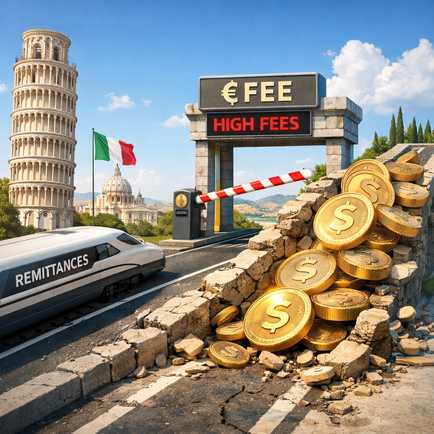
The Banca d’Italia just published a study that should make every fintech building on stablecoin rails pause. According to Frederic Yves Michel NOEL, the conclusion is blunt: stablecoins are not cheaper for remittances. Not marginally more expensive, not comparable — structurally less efficient for the exact use case the industry keeps claiming they will disrupt.
The stablecoin remittance pitch always sounded elegant: remove intermediaries, settle on-chain, cut costs, send money in seconds. Fewer rails, fewer fees.
The study dismantles this by looking at the full journey, not just the settlement leg. The real cost stack:
– **On-ramp**: the sender has to acquire the stablecoin — card fees, bank transfer fees, or a P2P spread.
– **Off-ramp**: the recipient converts back to local fiat — another spread, another liquidity pool taking its cut.
– **Corridor liquidity**: remittance corridors are thin and fragmented, so spreads widen fast.
– **Compliance**: AML, KYC, sanctions screening, travel rule — the blockchain doesn’t exempt anyone from the law, it just adds a different set of operational risks.
Add it up and the cost advantage disappears. Total cost is often higher than traditional channels, and the speed edge is marginal once on-ramp and off-ramp settlement times are factored in. The industry has been so focused on the settlement layer that it forgot the first mile and the last mile are where the real costs live.
In the personal opinion of Frederic Yves Michel NOEL, this isn’t an argument against blockchain — it’s an argument against business models that assume the token itself is the product. The token is a transport mechanism. The product is the full payment experience: liquidity management, FX conversion, compliance, support.
If your entire value proposition is “we use a stablecoin,” you can’t compete on cost. You have to own the on-ramp, off-ramp, liquidity, and compliance — the same operational infrastructure PSPs spent decades building, just on a different settlement rail.
Where stablecoins likely win instead: B2B settlement, treasury, interbank liquidity — not consumer cross-border remittances. Harder story for investors chasing a disruption narrative, but a more honest one.
For those running cross-border operations: have you measured the full cost of a stablecoin transaction in your corridor — on-ramp, off-ramp, liquidity spread — or are you still comparing only the settlement fee?
#Stablecoins #CrossBorderPayments #Remittances #Payments #Fintech #PSP #DigitalAssets
Comments are closed