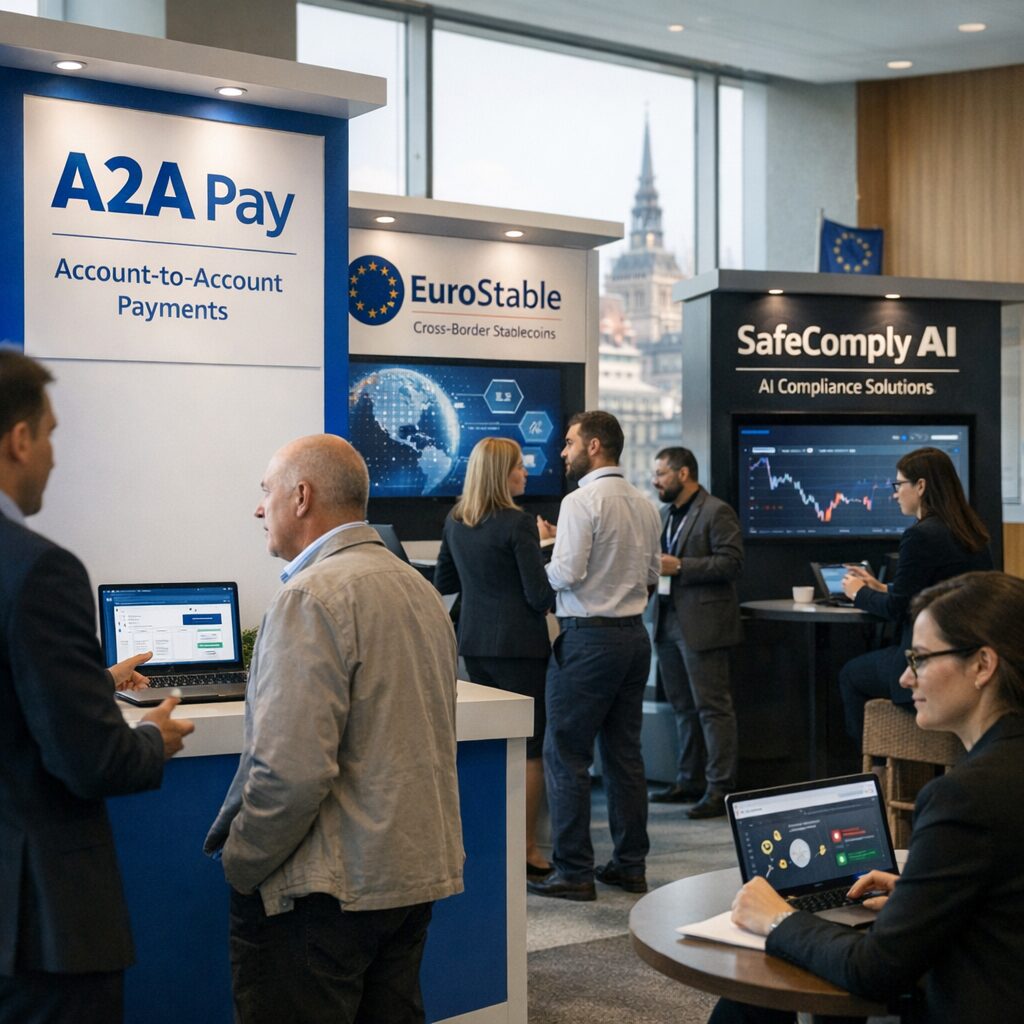
EBAday 2026 has just announced its lineup of 16 fintech finalists, and Frederic Yves Michel NOEL has provided insights into the three contenders that could significantly disrupt European payments.
The first finalist is an A2A challenger that aims to eliminate reliance on card networks. This innovative company is developing real-time account-to-account payment rails that bypass Visa and Mastercard entirely. For merchants, this means enjoying fees of less than 1%, while consumers benefit from instant settlement. However, the success of this solution hinges on the cooperation of banks with open banking data; without their support, this could remain a niche experiment.
The second finalist is focused on creating a stablecoin bridge for cross-border B2B transactions. This company utilizes regulated stablecoins to settle invoices in a matter of seconds rather than days. With an impressive daily volume of €750 million moving across borders and nearly zero foreign exchange slippage, the key to their success lies not just in the stablecoin itself, but in a robust compliance layer that identifies suspicious transactions before they are recorded on the ledger. This aspect is particularly appealing to regulators.
The third finalist is leveraging artificial intelligence with a compliance engine designed to eliminate manual reviews. This machine learning model has been trained on 70% of European payment traffic, allowing it to detect anti-money laundering (AML) red flags in real-time and automatically generate suspicious activity reports (SARs). One bank that is piloting this technology has reduced its review team from 40 to just 6 people, marking a significant transformation in efficiency and workforce management.
These three finalists are crucial to EBAday 2026 for several reasons. A2A payments are increasingly taking market share from card transactions in countries like Spain and Poland. The rise of stablecoins is prompting central banks to accelerate their digital euro initiatives. Furthermore, AI compliance solutions are essential for meeting the evolving ISO 20022 data requirements.
For those attending EBAday 2026, it would be wise to prioritize visiting these booths over the keynote speeches. For those who cannot attend, the developments from these finalists signal that the next 12 months will be critical in determining whether Europe will lead or lag in the realm of real-time, low-cost payments.
What are your thoughts on which of these three disruptors will make the fastest impact?
Comments are closed